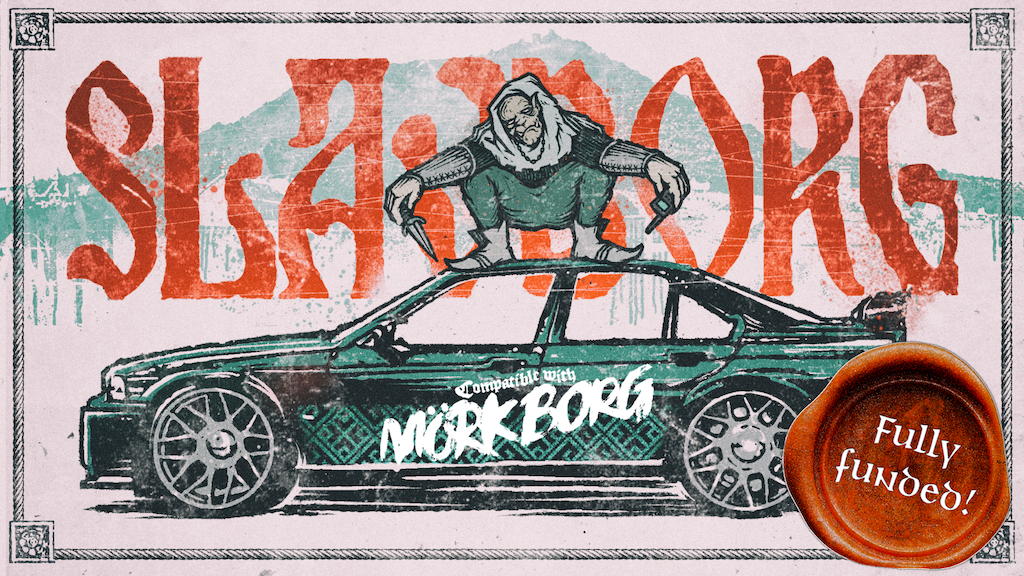
Rev the engines with your goblin crew, steal some sweet new orc wheels and put the brakes on the Eastern Bloc’s slimiest necromancer.
SLAV BORG is a stand-alone game that’s also compatible with MORK BORK and other OSRs. And you know what this means: tons of new tables, monsters, NPCs, and various additional components you can use to craft a playstyle and narrative that best suit your greedy spirit.
Latest Updates from Our Project:
Your future archenemy awakes
over 3 years ago
– Fri, Jun 23, 2023 at 08:01:24 AM
There are few witnesses to the Necromancer’s madness in the Realm of Zgol. They will swear that he occupies Landeskrrrone and the curse is as real as the weather anomalies that started to plague the majestic mountain recently. But who or what is he and to what secret goal his curse is working is unclear. One thing is certain: something happened in the year XX89 and nothing was the same since then.
The Necromancer by Bohun
The Necromancer is the main antagonist in SLAV BORG. He is, indeed, occupying Landeskrrrone, and the curse (sometimes called The Spell Of Transformation) is his doing. However, what are his origins, and, most importantly, the reason for his visit to this dimension, remain to be uncovered by the players. He is elusive and shrouded within the mists of magic and technology that is alien to this world. Keen eyes and sharp minds can trace threads of his influence: local businessmen like mighty Mister Tomato (Pan Pomidor), inept coal mine director Mirek Beetle (aka The Żook), or high-ranking pig troll police officer Zyeboos (aka The Efed Up), and many more. Unweaving this web of deception and corruption is one way that players can reach the truth about the Necromancer. But there are others, too!
Green Folk that populate the Realm of Zgol are aware that something is not right. In recent years work has been harder than usual, bosses and businessmen more greedy and ruthless, and streets more dangerous and addicted to deadly racing. Green Folk leader, wise sage Sara, found traces of unknown magic in the air. She reconstructed the spell and came to the shocking realization - it was not of this dimension, hostile and cruel. She investigated further and found out about a powerful entity from beyond this world, the Necromancer. Breaking the curse means confronting this being and this is where the players might come into the picture.
The Necromancer needs to go back to his dimension and the only way to do that is through the destructive and escalating power of the curse. He needs to see the Basilisk once more and whisper the possibilities of the worlds beyond their own. If he needs to sacrifice the dimension that he now occupies to achieve that, he won’t hesitate. Stopping the Necromancer is a race against time because the curse has almost reached its full potential, breaking the souls of the denizens of this world and deforming its climate to a lethal level.
fot. Piotr Bieniecki [www.fototeo.pl]
As with many things in SLAV BORG, the Necromancer was inspired by a real-life person - Leszek Balcerowicz who was a Minister of Finance after the fall of the quasi-communist authoritarian regime and the system transformation into a more democratic one, but mainly capitalistic and very neoliberal. Balcerowicz was at the front of the reforms that left a lot of people jobless, poor, and desperate. A lot of public services were cut or privatized, and the industries were either erased from existence or sold off for an absurdly small price. To this day he is the face of bloodthirsty, cruel ideas of hardcore and antisocial capitalism. For the vampires from the private sector, he’s a hero that made the country modern for everyone else he is more akin to a demonic entity that tore through the fabric of society with cold cruelty. There is no better villain for SLAV BORG.
We'regettingclosertothe finish line - keep your eyes peeled for more SLAV BORG insanity!
Penumbra City: A TTRPG Project That Stole Our Hearts
over 3 years ago
– Thu, Jun 22, 2023 at 08:16:18 AM
While browsing Kickstarter, we stumbled upon a project that immediately captured our attention. We couldn't resist backing it and sharing it with you. Allow us to introduce Penumbra City, a project that deeply resonated with us. We recently had a brief conversation about the similarities and differences in our approaches to creating TTRPGs set in dystopian cities, and we thought you might be interested in hearing about it.
Penumbra City is a rules-medium, campaign-world-rich tabletop roleplaying game designed for 3-6 players. It is already 80% written and is playable, we just need your help to finish the last round of playtesting and get it printed and into your hands.
Penumbra City is a class-based game with simplified core mechanics but a broad range of character class abilities. Healing is hard to comeby, so the decision to fight must never be taken lightly. While one player takes the role of the Game Master, players roll all dice. Most rolls are made with d20s. Penumbra City uses a reputation economy–it is a world where money has lost its luster, and it is a character’s reputation with the various gangs, factions, and coalitions that determine their access to resources.
If you're intrigued, you can support Penumbra City by backing it (only 8 days remaining).
Q:Both games are set in a distinct and deteriorating city plagued by crime. Could you provide more details about the real-life locations and events that inspired you?
Penumbra City: Probably the biggest single inspiration for Penumbra City is Weimar-era Germany. During the 1920s, Germany had a brief-lived republic that was trying its hardest to be beautiful, but all of these opposing ideologies were vying for control–social democrats, communists, anarchists, monarchists, and of course the fascists who won. But in that little brief window, so many experiments of freedom were tried–a lot of modern LGBTQ+ thought was developed in Berlin, and there was cabaret, and there were antifascists fighting tooth and bloody nail to stop the rise of Hitler. Margaret wrote a lot of the first draft of what later became Penumbra City while staying in a squat in Germany.
Then there’s 1930s Spain, with a pretty similar vibe–a republic was formed, but lots of people wanted anarchism, and lots of people wanted right wing dictatorship, and in the end a fascist army invaded. Again, there was this moment of desperate beauty, a moment where anything seemed possible.
Victorian-era New York City, too, because it was this place with so many cultures learning to live alongside one another in desperate poverty. And of course there’s an intentional allusion to the Industrial Workers of the World in the game, who in the real world are still around but had a heyday we’re drawing from more directly in the early 20th century, when people with different ideologies got together to create an anti-racist labor union to unite all the workers of the world.
SLAV BORG: The main one is the economic transformation of Poland after 1989. In our home region, the area between the Czech Republic, Germany, and Poland, it had severe consequences. The coal mine and the power plant were the only industry that was left. Thousands of people were left jobless and hopeless, and many of them turned to crime or small businesses in the grey sphere. Proximity to the borderland made some things really prosperous - smugglers were literally waging war against each other, using a corrupted police force and customs officers. The main city in SLAV BORG is Zgol, based on real-life Zgorzelec. It was a witness to conflicts between bandits, the severe heroin plague, and fortunes that were made overnight, mostly through illegal means. Social contrasts were almost shocking, with self-made barons and poverty-stricken populace living side by side. In the ‘90s it was a city of palaces and abject conditions in the concrete jungle of the block of flats. Neighboring Zgorzelec is the German city Goerlitz (or Gurlitz, as we call it in SLAV BORG), with Landeskrone (Landeskrrrone in the game), an extinct volcano, looming over it. Goerlitz was also deindustrialized but made almost a successful change into a tourist destination. It was all these contrasts and juxtapositions that inspired the crazy and surreal world of SLAV BORG.
Q: In Penumbra City, players embark on a mission to overthrow the oppressive rule of the God King, while in Slav Borg, their objective is to confront a capitalistic necromancer who has inflicted the curse of a free market upon the land of Zgol. Can you delve deeper into how these games embody an anti-establishment theme?
Penumbra City: Penumbra City embodies a three-way fight between differing coalitions, the Revolutionists, the Reasonable, who are mostly capitalists, and Bulwark which is heavily made of the church/state. These coalitions are made up of varying factions that are sometimes at odds with each other (which sounds nothing like the world we live in currently.) A lot of the social dynamics of navigating Penumbra City revolve around exploration of the relationships between these different factions. We hope that gameplay can involve having to navigate these relationships for the better. No one faction, or probably even no one coalition, is going to be able to take down the god king on their own. So as much as Penumbra City has narratives of tearing down the establishment it focuses on how to do that through building bridges between communities. An earlier version of the game allowed players to play as classes from any of the coalitions, but the current version focuses on the Revolutionists. And what that brings players is the experience of, instead of facing some unknown and vaguely monstrous enemy ala many TTRPG worlds, they’re facing the everyday repression from the authorities of their city.
SLAV BORG: The Realm of Zgol is so disjointed by private interests that there is almost nothing resembling the establishment in the traditional sense. However, there are some points of resistance, especially in the faction that we call Green Folk. They are honest workers, closely related to Nature and its magic, but are suffering from a lack of respect from their bosses and health risks associated with their work. They also feel the injustice that is the existence of mere bandits that are rich and powerful, but brutish, greedy, and ignorant. Players can choose to help out Green Folk in many ways and this act of strengthening the community is the most defiant and effective way of fighting with anti-social Necromancer.
Q: How do the game mechanics contribute to the creation of the presented world and reinforce its unique atmosphere?
Penumbra City: With Penumbra City, we wanted mechanics that felt fairly simple while offering a lot of flavor. We wanted combat to feel easy but for characters to be able to do kind of complex things within that. A lot of the flavorful abilities that characters have are the pieces of the classes that make them unique or tie them to the archetype, lore, or history that is behind the creation of the class. For instance, anarchists throughout history have really loved bombs, so one of the anarchist factions has abilities centered around using bombs. Bikes have also been a really vibrant part of anarchist culture. Inmn used to go watch people bike joust on tall-bikes, so it makes sense that the Doggirls, the crusty punk faction in Penumbra City, is going to have abilities centering around using lances on freaky motorcycles. Penumbra City is a class-based game, but these classes have feeling and history tied to them and we wanted that to shine through. When players pick the Clacker class, we wanted it to be easy to access the feeling of being a hacker who’s obsessed with building bombs, or when playing a Doggirl, to have the feeling of being one of those well-liked punks that throw good parties, so they have an ability that just let’s them say, “Oh, I know them” about an NPC in a crowd. We built history, culture, lore, and politics into the abilities of the classes because those little bits of lore and culture are what makes history and stories so fascinating.
SLAV BORG: With the transformation came the destruction of almost all of the public sphere, including public transportation. That’s why Wheels are one of the most important things in SLAV BORG. A car is not only a means of transportation but also a symbol of status and the best way to resolve any conflict. Driving mechanics are not limited to racing but also to a special type of dungeon - smuggling operations. Players will have to change their strategy and be even more cunning and deceptive than in a regular race.
When it comes to the maze-like blocks of flats, we chose to put them in a separate dungeon category, which is more survival horror oriented. Cramped spaces, limited resources, and the great unknown that is around every corner will sum up to tense and atmospheric gameplay.
Q: So… why now? How does the current state of the world tie into how you figure your game will be played?
Penumbra City: Some of us in the colonial core, like the United States, are seeing a lot of stability fall apart. Things we felt we could take for granted. Not that the political stability of the US has always done good for people–usually the opposite, but for a lot of us, it’s seemed a bit unshakable. It’s not unshakable. I mean, realistically, the “why now” is because the game is, after years of development, more or less ready. We’re on our last round of playtesting and are finalizing some writing and art. But in terms of how the game will be played, I suspect how much so many of us have skin in the game in the real world will make roleplaying and escapism all the more enjoyable.
SLAV BORG: Honestly, we don’t know, because a lot of people play RPGs to escape reality, not to be reminded about it. However, there is always a subset of players that want to channel the real-life experience into some form of entertainment or even maybe work through some stuff through role-playing. There is also a fact that for us SLAV BORG is something that literally hits close to home, but for a majority of our prospective players it’ll be something unique, alien, or even exotic. And that’s fine because, at the end of the day, RPGs are a way to make your life more exciting, not more depressing!
As for why now, the answer is simple. As much as we got literature and discussion about the transformation and the time around it, we never got into later years, the beginning of the XXI century. And SLAV BORG takes this time and turns it into madness-inducing, goblin-fueled entertainment. It’s not as ambitious as an academic dissertation, but is helping us cope with our own history and personal experience!
Thank you for taking the time to read our post, and we sincerely hope you found it enjoyable. If Penumbra City has captured your interest, we kindly ask you to express your support and show them some love by backing their project on Kickstarter. You still have 8 days left to do so.
The lifeblood of SLAV BORG
over 3 years ago
– Tue, Jun 20, 2023 at 07:55:19 AM
The post-Soviet transformation wasn’t smooth. Vast groups of people were deprived of work, and the social fabric of the industrial society was torn apart. Leaving space for bandits, scammers, smugglers, and all sorts of criminals to swoop in. Fortunes were made and lost in a matter of days, and desperation and frustration crept in, offering a perfect way for drugs and alcohol to ravage the local populace even more. What was left was a divided society, with parts that were living like feudal lords and parts that were left in a state of constant grind, sometimes with a lining of illegal hustling for good measure.
We translated these experiences into some parts of the SLAV BORG game. Most importantly, the Green Folk faction. Goblins, hobgoblins, kobolds, and gnomes are working hard. Under the boot of the local business vampires - called Januszex - and for the back-breaking and illness-inducing Coal Mine. They are a savvy and tough bunch, despite being tormented by the larger and stronger forces of capital and greed. They usually live in blocks of flats, each day feeling the weight of the unfair social system getting heavier and heavier. They can and will unite when the occasion arises, and one of their leaders - old goblin sorceress Sara - is assembling them now to stand against the Necromancer that turned the local greed and unjustness up to eleven. Players can stand with or against them. Helping Sara to achieve their goals will most likely help them too, however, it won’t be a fair or easy battle to fight.
You can find the Green Folk almost anywhere in the Realm of Zgol. In the depths of the Coal Mine, in the labyrinthian corridors of Manhatan, on the streets where races are tumbling down. They will help You out in any way they can, of course, if you’ll earn their trust. Guarding the workers’ strike, cleaning out the mechanical monstrosities that roam around the dungeons in the basements of Zgol, negotiating with a local vampire businessman that is exploiting his employees to the point of tragedy - there is a lot to do when it comes to justice and safety for the Green Folk.
The Green Folk is one of the six factions of SLAV BORG. Factions are a crucial part of the roguelike mode of the game and getting them on your side (or neutralizing them one way or another) is a key to victory against the Necromancer. Of course, chapters on the game’s factions are not limited to use in one mode, but they’re essential elements of worldbuilding. They will provide an in-depth description of the faction, depictions of the most important NPCs, hooks for possible scenarios, and much, much more.
Stay tuned for the reveal of the SLAV BORG’s main antagonist - the sleazy Necromancer.
NEW LOCATION - mythical mountain
over 3 years ago
– Thu, Jun 15, 2023 at 09:03:15 AM
is an extinct volcano that is looming over the Realm of Zgol. Home of the twisted Necromancer, it's a crucial point on the SLAV BORG's map. Players have to reach its summit if they plan to free the Ream from the curse, but this will be hard without proper information and - especially - preparation. Landeskrrrone is the final location of the roguelike mode but can be easily used as a base for the one-shot scenario as well. However, it's highly irresponsible to go there on a whim - think of it as a more endgamelocation for crews experienced in the madness of SLAV BORG.
Landeskrrrone is based on the real-life volcano, Landeskrone, in Goerlitz, Germany. Of course, it's been extinct for almost 30 million years now. Despite its relatively small height - 420 meters above sea level (blaze it!) - it stands far and above the surrounding terrain, mostly planes. It was a point of interest for the local populace for centuries. Early Slavic tribes saw it as a magical mountain and an excellent place to conduct religious rituals, including human sacrifice. But later, Landeskrone became a very hard to conquer fortress, castrum landischrone.
So, around the XVth century, it had to be destroyed because it was a perfect place for bandits to set up their camp and harass the neighboring settlements. Throughout the later years, the summit of Landeskrone became an astronomic observatory, and it housed various armies taking part in disastrous wars that were waged in the region. Finally, in the XXIst century, it's one of the most interesting tourist destinations in Goerlitz, providing breathtaking views of the area: Polish, German, and Chech parts.
Source: Mario Förster/ostsachsen.de
We naturally took this exciting history and weaved a new, fictional layer around it. Landerskrone makes for a great place of magical power, one that is enveloped in the nasty schemes of the Necromancer and shrouded in mystery. Channeling real-world places and stories into the fictional gears of the tabletop games is the staple of Slavdom Studio, and you can rest assured that much more is coming!
Source: goerlitz.de
Thank you for taking the time to read this update. We appreciate your ongoing support and enthusiasm for SLAV BORG. As we continue to bring this game to life, we'd love to hear from you, so share your thoughts in the comments below, join our Discord, and Tweet us.
The smell of gasoline intensifies!
over 3 years ago
– Mon, Jun 12, 2023 at 09:00:25 AM
OK, we’re fully funded! That’s pretty great, but we still have some goals to clear, mainly the freaking awesome modular racing track.
Now, SLAV BORG offers a lot of different playstyles, but almost any scenario you will procure with your players will interact in some capacity with Wheels. Wheels is an umbrella term for everything related to cars, from the methods of stealing, sorry, acquiring them, infiltrating the gambling circles, to high-octane races that you can win in a more or less honorable manner. Today we will look at one of the most important chapters in the book - WHEELS.
Many things changed when the Necromancer covered the Realm in the toxic fabric of the curse. Before, cars and other motor vehicles were just tools, a way to get from here to there. Public transport spun the web of connections. They weren’t always on time and weren’t necessarily luxurious when it came to comfort, but they were there, and you could easily get from one part of the Realm to the other. After the curse befallen the land, Necromancer’s minions tore this web apart, leaving the denizens of Zgol stranded and confused. This toxic spell flew on the wings of greed and contempt; thus, the new era began. The era of WHEELS.
Of course, you can live in Zgol without owning a car. But then you are not only treated as a pariah but you’re also cut off from the variety of profit avenues. And what about safety? Are you so tough that you can frolic around the streets with no sidewalks in sight? Wheels, for better or - let’s be frank here - for worse, are life here. And death. Lots of it.
Auto Catalogue is a diverse selection of vehicles, from classics like Maluch and Polonez to new bad boys in town in the form of SUVs and expensive sports cars. Each vehicle is provided with a stat line - some of them are bulky and highly effective in combat situations but slow and not very maneuverable. Others will zip past anyone else, but one precise hit will send them to the junkyard. Choosing the right car for the right circumstances is the key to surviving on the streets of Zgol.
You will get hooked up on the constant upgrading of your car, turning it from a measly family vehicle to the beast that will strike fear in the hearts of your rivals.
Grease And Lease is a segment that will provide every info on the servicing infrastructure you need. Chop shops, car dealerships, parking, garages, workshops - legal or not, there are a lot of points of interest in Zgol that will help you out in getting new wheels, taking care of the old ones, storing or just straight up buying whatever shady loot that you’ll bring them. Traditionally, they are run by the gnomes, one of the most underrated Green Folk in the Zgol. Tinkerers, mechanics, and all sorts of fixers-uppers will lend you their hand, ear, or gossip about anything related to wheels. For a price, of course. Chop shops are crucial for installing new parts and repairing the damage that your car will surely sustain at some point. Better engine, more durable tires, maybe some weapons on a side - the gnomes will get you covered. Again, for a price.
Vroom is all about racing. Starting with the mechanics of high-speed contests, where the risk/reward system will test your nerves and cunning. Each class in SLAV BORG has at least one skill that is connected to the Wheels. You can be a great driver or an important technic on the sidelines.
But you can also manipulate the situation from the shadows by sabotaging your rivals or rigging and corrupting the gambling circles. You don’t have to be put in the box of death to achieve your goals; shrewdness is also a trait that will increase your chances of survival. Not to mention getting rich. Just saying!
Your car is not just a puny vehicle. It’s also a weapon of destruction. Vroom will provide a comprehensive guide for using traps, obstacles, and other means to make your opponents’ lives miserable. You will be using oil spills, caltrops, chains, and barely visible fly lines in no time.
From Gurlitz Grand Prix to the race through the crazy wilderness of ever-changing Zgol Backwoods, there are many races to participate in. Vroom will provide you with the rules for constructing your own dungeon-like races and tossing in a few classic ones, ready to use straight from the book. If the stretch goals are unlocked, you will also get a set of tiles that can spice up your tabletop adventures. However, SLAV BORG is an RPG at heart, and as much as we encourage you to work on your own racing tracks and kitbashing some cars (Matchbox and Hot Wheels are pretty great bases for that!), you can easily use your own imagination, pen, and paper.